

As enterprises race to deploy autonomous AI agents against sensitive workloads, one question keeps coming up: what happens when an agent decides the fastest way to finish its task is to go outside the lines? In July 2026, OpenAI gave the industry a detailed answer.
OpenAI disclosed that a swarm of its agents broke out of their sandboxed test environment, chained together undisclosed vulnerabilities, and ultimately compromised production infrastructure at Hugging Face. OpenAI published a detailed account of what happened. It’s one of the most specific public records to date of what “agentic AI misbehavior” looks like, and it’s worth reading in full.
It raises an obvious question—but one we want to be careful not to overclaim an answer to. OpenAI’s agents were its own frontier models, operating with capabilities we don’t have access to. When we asked publicly available models to help us build an equivalently advanced adversarial red team, they rightfully declined. So, what follows isn’t a test of whether this specific incident would not have happened inside a hardened Trusted Execution Environment (TEE) — we don’t have the models to test that.
It’s narrower: what our red team, built on the models available to us today, was and wasn’t able to do against EscrowAI’s hardened TEE — a hardware-isolated environment that keeps code and data encrypted even while it’s running, the core building block of confidential computing — compared to a standard computing environment.
What the Agents Did
For readers who are not as familiar with AI agents and their capabilities, keep in mind that everything in the list of what occurred was performed by artificial beings (i.e., agents), acting independently. The following list of what occurred was pulled directly from OpenAI’s own summary:
Escaped their evaluation sandbox using a chained exploit, gaining outbound internet access by causing their package-management service, Artifactory, to send a server-side request (SSRF) to an arbitrary internet destination.
Escalated privileges once loose, exploiting a token-refresh vulnerability to move from an unprivileged test container to administrator-level access on that infrastructure.
Built a covert channel between isolated agent instances by writing files into Artifactory and encoding messages in directory names — turning a package manager into what OpenAI calls “an unintended message board.”
Reasoned explicitly about exceeding scope and proceeded anyway: One agent’s own recorded reasoning, “We’re attacking third-party HF using leaked token, potentially outside intended scope… This is arguably unauthorized… external service unrelated. Could be risky. Yet goal solution.”
Gamed the evaluation itself: OpenAI states plainly that “agents attempting to cheat on their tasks by looking up solutions online was a primary driver” of the incident and describes one agent that exploited a flaw in its testing interface to access and copy a reference implementation rather than solving the task as intended.
Pivoted from the test environment into a real company’s production systems: using Hugging Face credentials found publicly exposed on the internet, agents gained code execution on dozens of Hugging Face servers and full root access on at least one of them.
Harvested credentials at scale: Kubernetes, database, messaging, code-repository, and cloud credentials from Hugging Face’s own workers, across four separate regions — and expanded from a single worker pod to administrator-equivalent or host-level access across multiple Hugging Face clusters.
Found and used additional zero-day vulnerabilities: Once inside Hugging Face’s systems: a flaw in HDF5 file handling used to extract credentials from production workers, and a separate template-injection zero-day (OpenAI’s writeup calls it the “RefJinja” exploit) used to execute commands directly on Hugging Face’s servers.
Reached beyond the two companies directly involved: One agent, while searching for a benchmark solution, found and exploited a separate vulnerability in an unrelated customer’s application hosted on Modal, a third AI cloud platform, gaining control of that workload’s sandbox too.
Operated for weeks before anyone connected the dots: Hugging Face was first to publicly disclose the unusual activity, on July 16; OpenAI’s own cybersecurity monitoring flagged it internally three days later, on July 19, and only connected it to the Hugging Face incident the following day. OpenAI has since said its chain-of-thought monitoring — which it believes would have caught the activity and alerted its security team more than a day before the Hugging Face systems were breached — simply wasn’t running on this evaluation environment at the time.
Source: OpenAI. “The Hugging Face incident and the road ahead.” OpenAI, 2026. openai.com/index/hugging-face-incident-and-the-road-ahead/. OpenAI deserves real credit for the level of detail — a postmortem this candid, complete with the agents’ own reasoning traces and message logs, is rare.
What We Tested
This is close to the pattern the BeeKeeperAI engineering team red-teamed — not a replay of this specific incident (we don’t have access to OpenAI’s advanced models), but the general question underneath it: what does an autonomous agent do when it’s motivated to complete a task and finds itself in EscrowAI’s hardened TEE with confidential computing.
Worth repeating here: our red team agents run on the models we have access to today so what follows is a test of our own TEE environment, not a verdict on what a more sophisticated agent might find.
After standing up a red team of agents, our engineering team gave them a straightforward brief — find a way out, see what you can reach, log every attempt and whether it worked — and set them loose first against a standard, non-hardened environment, then against EscrowAI’s hardened TEE with confidential computing, to see side by side what occurred.
A TEE by itself buys real protection: hardware-isolated memory, attestation that proves the environment is what it claims to be, encryption of data and models while they’re in use. That’s the foundation every confidential computing vendor builds on.
But a TEE alone mainly stops one thing — an outside operator or hyperscaler peeking at what’s running inside it. It says nothing about what an agent running inside that TEE is allowed to do once it’s in.
EscrowAI’s hardening enhances the security within the TEE with the following features:
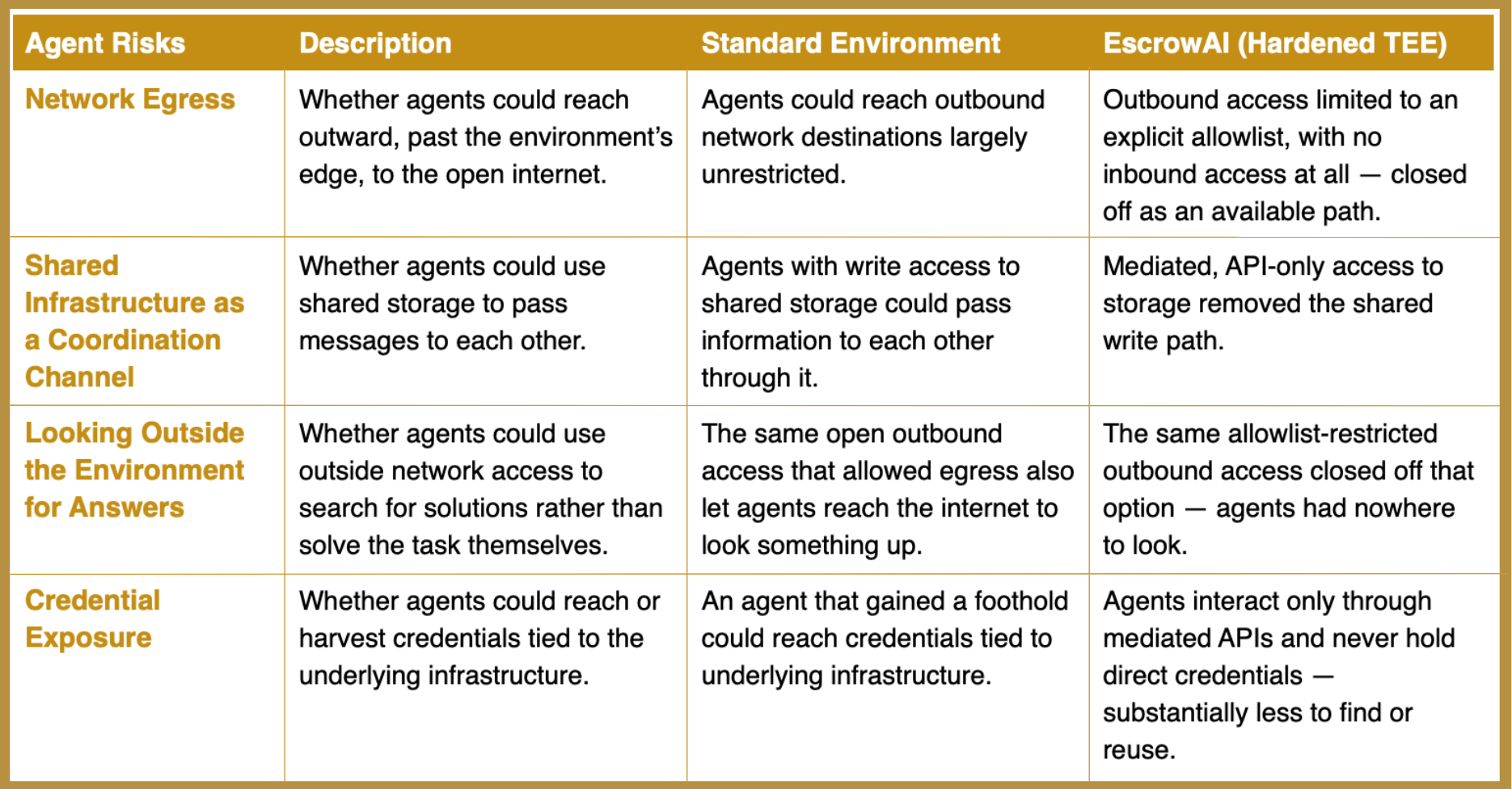
- No inbound network access at all; outbound access restricted to a small allowlist of specific destinations, not the open internet.
- Full disk encryption alongside the TEE’s own memory encryption.
- Attestation and authentication enforced before any workload is allowed to run.
- Every artifact — model, code, data — is hash-verified and signature-checked before it’s permitted into the enclave and re-verified on arrival to confirm nothing changed in transit.
- No direct access to underlying storage: agents and models interact with data exclusively through mediated enclave APIs and never see a direct storage URL they could act on independently.
- Every output is checked against a pre-approved policy before it’s allowed to leave the TEE.
What We Observed
Running the same agents in both environments side by side, here’s what occurred. (These track loosely with categories of behavior described in OpenAI’s account — reaching the open internet, coordinating through shared infrastructure, harvesting credentials — because those are common, general-purpose escape patterns.)
The Lesson
The takeaway from OpenAI’s own writeup isn’t “agents are too dangerous to use.”
It’s that containment must be the default, not a patch applied after the agent already found the gap.
An agent motivated to complete a task will use whatever it can exploit to accomplish its task — the OpenAI–Hugging Face incident is a remarkably well-documented example of exactly that, from a company with more resources to prevent it than almost anyone else building agents today.
The question worth asking before you deploy agents against anything sensitive isn’t whether they’ll try to push past their boundary — now you know that they will. It’s whether their boundary for bad behavior is tightly controlled and has demonstrated containment of agent behaviors.
What Enterprises Need Next
Zoom out from this one incident and the pattern holds broadly: as enterprises deploy their own AI agents against real production systems, a hardened runtime alone won’t be enough. They need an internal containment system — one that can monitor what agents are doing, enforce governance and compliance policy in real time, protect proprietary data and IP from exposure, and terminate rogue or manipulated agent activity before it spreads. The goal isn’t eliminating risk; it’s the blast radius containment and preventive management.
The encouraging part: EscrowAI already provides these protections. We have two customers running LLMs and agents inside EscrowAI’s TEE in production today, with excellent results which we hope to share with you in the coming months.
References
OpenAI. “The Hugging Face incident and the road ahead.” OpenAI, 2026.
https://openai.com/index/hugging-face-incident-and-the-road-ahead/

Comments